



How Harvest, Handling & Drying Shape the Quality of Medicinal Herbs


Medicinal herbs are often encountered at their end point - dried, cut, and ready for use. But the quality of a herb is shaped long before this stage.
It begins at the very start of the plant's life cycle - with the seed.
The way a herb is grown, the conditions it develops in, and the care taken in its early stages all influence the structure and vitality of the plant that is eventually harvested.
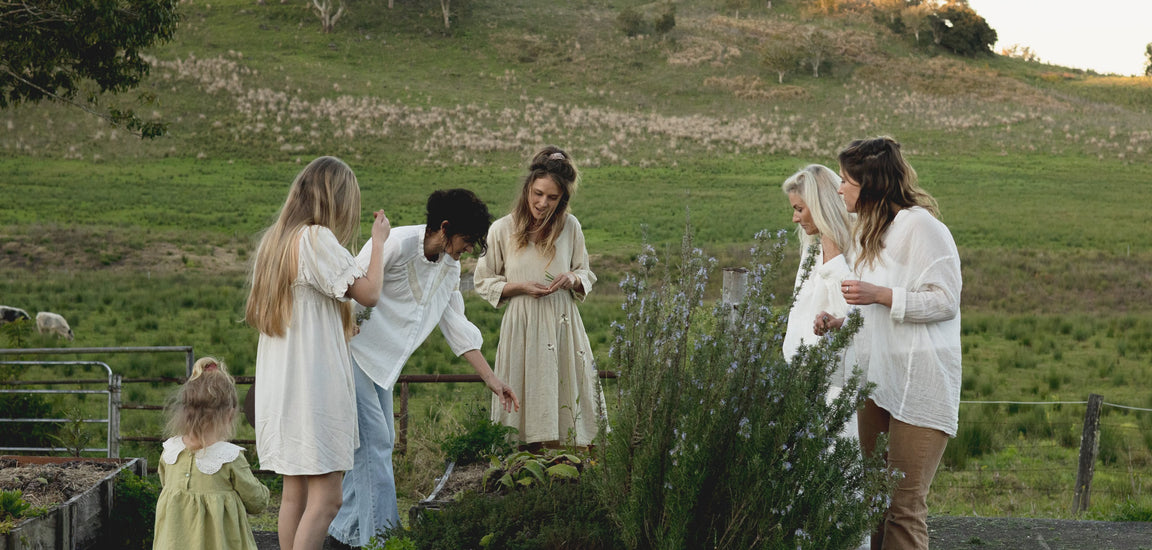
As part of developing the House of Herbs garden, I've begun growing a number of key herbs from seed - including Calendula and Chamomile. This stage is slow and largely unseen, but it forms the foundation for everything that follows. This is a trial & error phase and I am no expert at this. As you can see...
While seed propagation sets the foundation, the stages that follow - harvest, handling, and drying - determine how much of that original quality is retained.
Chamomile (Matricaria recutita) offers a clear example of this.
Harvest: Preserving the Integrity of the Flower
With Chamomile, the flower head is the medicinal component. It contains the volatile oils, flavonoids, and other constituents that contribute to its therapeutic profile. Preserving the integrity of this structure at harvest is essential.
Flowers are typically collected using a harvesting comb - a tool designed to gently lift the flower heads from the stem. Variations of this tool have been used, but grower Greg Whitten notably adapted a blueberry harvesting comb for Chamomile, adding a guard to prevent the light flowers from being displaced during collection. It is a small modification, but one that reflects a broader principle: that even minor inefficiencies or damage at harvest can affect the final quality of the herb.
The aim at this stage is simple - to gather the flowers cleanly, with minimal disruption to their structure.
Handling: The Often Overlooked Stage
Once harvested, Chamomile flowers are highly sensitive to handling and drying conditions, with quality closely tied to how quickly and carefully they are processed.
The fresh flowers are soft and moisture-rich, making them prone to compression and bruising. Rough handling, compaction, or delays before drying can lead to:
• loss of volatile compounds
• discolouration
• microbial activity
Handling, then, becomes a continuation of harvest - requiring the same level of care and attention. Flowers are moved quickly and gently into the drying environment, ideally spread in thin, even layers to allow adequate airflow.
This stage is rarely visible to the end user, but it plays a significant role in determining the quality of the finished herb.
Drying: Where Quality Is Preserved - or Lost
Drying is one of the most critical stages in medicinal herb production.
The objective is to remove moisture efficiently while preserving the plant's active constituents. For Chamomile, this means maintaining:
- the characteristic golden-yellow colour of the flower heads
- the distinct aroma
- the integrity of its volatile oils
At Bronzewing Farm, this is achieved through a passive solar drying system. Thermal mass - such as sun-warmed stone - absorbs heat during the day and gradually releases it, allowing warm air to rise through racks of drying flowers. This creates a slow, controlled movement of air that removes moisture without exposing the plant to excessive heat or direct sunlight.
This method reflects a deliberate choice: to work with natural energy systems rather than rely solely on forced heat. The result is a more stable drying environment, one that helps preserve the subtle characteristics of the plant.
However, drying is always influenced by external conditions. In periods of high humidity or unsettled weather, passive systems alone may not be sufficient. In these cases, a supplementary heated drying method is often required to stabilise the process and prevent spoilage. When used carefully, this allows growers to maintain quality while adapting to less favourable conditions.
A Shift Toward Quality
In the early development of Australia's medicinal herb industry, Greg Whitten, a pioneer of medicinal herb cultivation, observed a clear disparity between locally grown, carefully handled herbs and imported material. Much of what was available at the time had been harvested and dried with little regard for quality, resulting in herbs that were dull, low in aroma, and diminished in effectiveness.
His work helped highlight a different approach - one in which harvest, handling, and drying were treated as integral components of herbal medicine production, rather than secondary steps.
This perspective remains relevant today.
From Plant to Preparation
Once properly dried, Chamomile becomes a stable raw material, suitable for a range of preparations.
As an infusion, it offers a mild bitter-aromatic profile associated with digestive and nervous system support. As an infused oil, it provides a gentle, soothing action for the skin. As a tincture, it allows for broader extraction of its constituents.
Each preparation draws on different properties of the plant, but all depend on the quality of the starting material.
Conclusion
Chamomile illustrates a broader principle in herbal medicine: that quality is cumulative.
It is not determined by a single factor, but by the sum of many small decisions -how a plant is grown, harvested, how it is handled, and how it is dried.
These processes are often invisible, yet they leave a clear imprint on the final herb.
You can see it in the colour, the aroma, and ultimately, you can observe it in the way the herb performs.


Leave a comment
All comments are moderated before being published.